
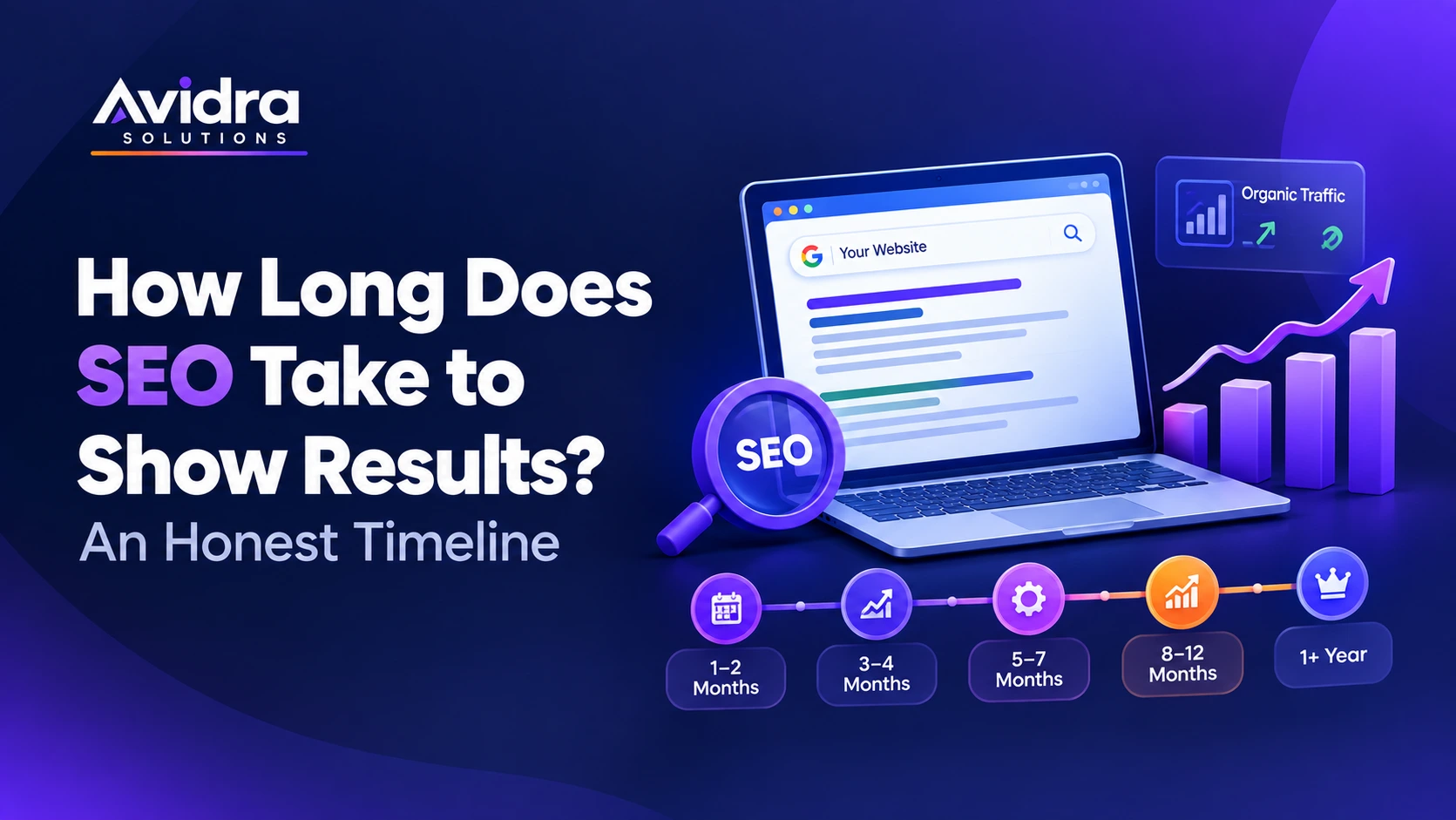
How Long Does SEO Take to Show Results? An Honest Timeline
If you’ve searched this question hoping for a straight number — three months, six months — the honest answer is: it depends. But “it depends” isn’t useful on its own, so let’s break down what it actually depends on, and what a realistic timeline looks like.
Most businesses starting SEO have been through some version of the same experience: someone promises fast rankings, months go by, results are underwhelming, and the whole thing gets written off as “SEO doesn’t work.” In almost every case we’ve seen, the issue wasn’t SEO itself — it was a timeline that was never realistic to begin with.
Why There’s No Fixed Number
SEO timelines vary because every website starts from a different place. A five-year-old website with decent content and a handful of backlinks is playing a completely different game than a website launched last month with zero history. Several factors decide how fast things move:
- Website age and existing authority — older, established sites with some trust built up tend to see movement faster than brand-new domains.
- Competition in your industry — ranking for “lawyer in a small town” is a very different challenge than ranking for “lawyer in Delhi.”
- Current technical health — if your website has crawling or indexing issues, nothing else matters until those are fixed. Our technical SEO work often has to happen before content improvements can even register with Google.
- Content quality and consistency — publishing one blog and waiting isn’t the same as consistently building out topics your audience is actually searching for.
- Backlink profile — a website with zero external references has to earn trust from scratch, which takes longer than strengthening an existing one.
Two websites doing identical work can see different results simply because they started from different starting points. That’s not an excuse — it’s just how search engines evaluate trust over time.
A Realistic Month-by-Month Timeline
With that context in mind, here’s what a typical, honestly-run SEO effort tends to look like for a small-to-mid-sized business website.
Months 1–2: Foundation
This phase is mostly invisible from the outside. Technical issues get fixed, existing pages get optimized, keyword research and content planning happen. Don’t expect ranking movement yet — this is groundwork, not growth.
Months 3–4: Early Signals
New and improved pages start getting indexed. In Google Search Console, you’ll typically start noticing impressions increasing before clicks do — search engines are starting to show your pages, even if not yet in top positions. Long-tail, lower-competition keywords may start showing early movement.
Months 5–7: Momentum Builds
If the work has been consistent, this is usually when things start feeling real. Some target keywords move into page one, organic traffic grows month over month, and you start seeing which content types and topics are performing best.
Months 8–12: Compounding Growth
More competitive keywords start moving, older content gets refreshed based on what’s working, and traffic growth tends to accelerate rather than stay linear. This is where SEO starts paying for itself in a way that’s hard to replicate with ongoing ad spend.
Year 2 Onward: Established Authority
With a strong foundation, this is where the compounding effect really shows. Rankings become more stable, new content ranks faster because the domain already has established trust, and the cost of maintaining visibility drops significantly compared to the initial build-up phase.
Think of it like fitness. Nobody expects visible results from the gym in week two — but by month six, consistent effort clearly shows. SEO follows a similar curve: slow and unremarkable at first, then noticeably compounding if the work has actually been consistent.
What to Watch While You Wait
Rankings and traffic are lagging indicators — they show up after the groundwork has already been laid. While waiting for those, there are earlier signals worth tracking in Google Search Console:
- Impressions — is your website starting to show up for more searches, even if you’re not clicking through yet?
- Average position trends — are your target keywords slowly climbing, even from position 40 to position 25?
- Indexing status — are new pages actually getting indexed, and how quickly?
- Click-through rate — as titles and descriptions get refined, is CTR improving even at the same position?
These metrics move earlier than rankings, and tracking them helps separate “SEO isn’t working” from “SEO is working, but the visible results haven’t caught up yet.”
The Most Common Mistake: Switching Strategy Too Early
A pattern we see often: a business starts SEO, sees no dramatic change in month two, assumes it isn’t working, and either abandons it or pivots to a completely different keyword strategy. This effectively restarts the clock, because search engines were still in the process of evaluating the previous approach.
SEO rewards consistency far more than it rewards frequent strategic pivots. If the fundamentals — on-page optimization, technical health, and genuinely useful content — are solid, the better move is almost always to stay the course and let the timeline play out rather than restart every few months.
Can Anything Speed This Up?
Some factors do help accelerate the process, though none of them replace time entirely:
- Starting with a technically clean website rather than fixing issues along the way
- Targeting realistic, lower-competition keywords first rather than the most competitive terms in your industry
- Consistent publishing rather than sporadic bursts of content
- Earning genuine, relevant backlinks through link building or guest posting rather than waiting passively
- Strong local signals if your business serves a specific area, through local SEO
None of these turn SEO into an overnight process, but they can meaningfully shorten the gap between starting and seeing real movement.
Want a realistic timeline for your specific website?
Get a free consultation and we’ll assess where your website currently stands and what a genuine timeline looks like for your industry and competition.
Get a Free SEO ConsultationFrequently Asked Questions
Can SEO show results in one month?
It’s uncommon for competitive keywords, though low-competition, long-tail terms can occasionally move faster. Most meaningful results build up over three to six months at minimum.
Why did my rankings drop after a few months of SEO work?
Temporary fluctuations are normal as search engines re-evaluate your website, especially after content or structural changes. A consistent downward trend over a longer period is worth investigating, but short-term dips are usually not a cause for concern.
Does a new website take longer to rank than an older one?
Generally, yes. Search engines tend to trust domains with some history and established signals more readily than brand-new ones, so new websites typically need a longer runway before ranking well.
Is it normal to see no visible change in the first two months?
Yes. The first couple of months usually involve technical fixes, planning, and initial content work — this stage is foundational and rarely shows up as visible ranking movement yet.
Should I stop SEO if I don’t see results in three months?
Generally not recommended. Three months is often still within the early-signal phase. Switching strategies too early is one of the most common reasons SEO efforts underperform.




One Comment